


The AI Tutor Revolution: Why Schools are Replacing Textbooks with Personalized Algorithms
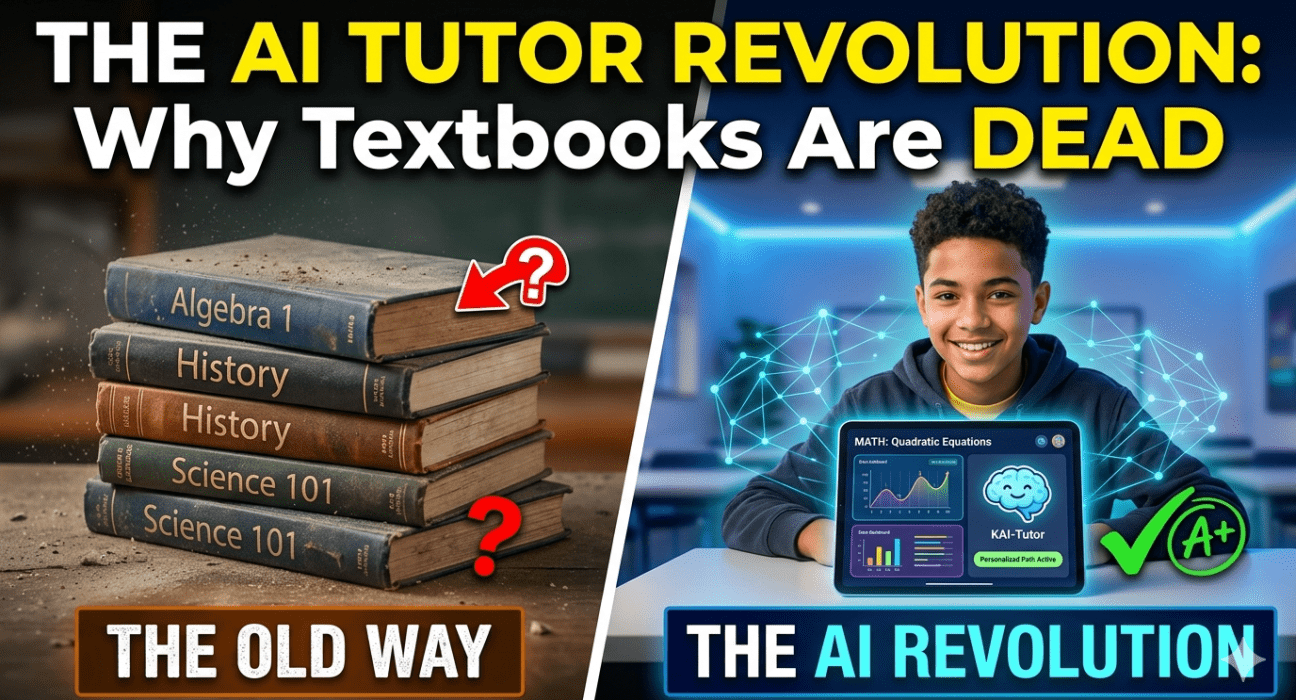
In the quiet corners of modern classrooms, the familiar “thud” of a heavy textbook hitting a desk is being replaced by the soft glow of tablets and the silent hum of neural networks. We aren’t just witnessing a change in tools; we are seeing the end of the “industrial model” of education.
For over a century, the textbook was king. It was a one-size-fits-all solution that assumed every thirty students in a room learned at the exact same pace. But in 2026, the script has flipped. Schools are pivoting toward Personalized AI Algorithms—digital tutors that don’t just deliver information, but understand the student.
The Death of the “Average” Student
The fatal flaw of the textbook is its static nature. If a student misses a concept on page 40, page 41 becomes a wall of gibberish. AI tutors, powered by models like LearnLM and ThetaWave, eliminate this “knowledge debt.”
These algorithms perform what educators call Dynamic Scaffolding:
- Real-Time Adaptation: If a student struggles with a quadratic equation, the AI doesn’t just show the answer. It detects the specific step where the logic failed and provides a Socratic hint.
- Infinite Patience: Unlike a crowded classroom where a student might feel embarrassed to ask for the third time, an AI tutor offers non-judgmental, repetitive support until the “lightbulb moment” occurs.
- Multimodal Engagement: While a textbook is restricted to text and static images, AI tutors generate interactive simulations, voice-guided explanations, and even AR experiences on the fly.
Efficiency by the Numbers
Recent data from early 2026 shows that the shift isn’t just a trend—it’s a performance powerhouse. A World Bank study revealed that students using AI-powered instruction achieved double the learning gains compared to traditional lecture-based groups. Perhaps more importantly, they reached these milestones in 20% less time.
The Teacher’s New Role: From Lecturer to Mentor
The fear that AI will replace teachers is being debunked by the reality of the 2026 classroom. Instead of spending hours grading repetitive worksheets or drafting lesson outlines, teachers are using AI to handle the “administrative heavy lifting.”
By automating the “delivery” of facts, teachers are reclaimed for high-value human work: mentorship, emotional support, and critical thinking guidance. The AI handles the what, while the teacher focuses on the why.
The Road Ahead: Ethics and Access
The revolution isn’t without its growing pains. Educators are now grappling with “the illusion of learning”—the risk of students becoming overly dependent on AI prompts rather than developing independent grit. There is also the critical challenge of the Digital Divide; if only wealthy districts can afford high-end personalized algorithms, the gap in educational equity could widen.
“Instead of being confined to set moments, instruction can respond as learning happens, guiding students through their thinking and helping them build understanding in real time.” — Rajen Sheth, CEO of Kyron Learning