





The Code Has Spoken: Why 2026 is Becoming the Year AI Subscriptions Overtook Netflix
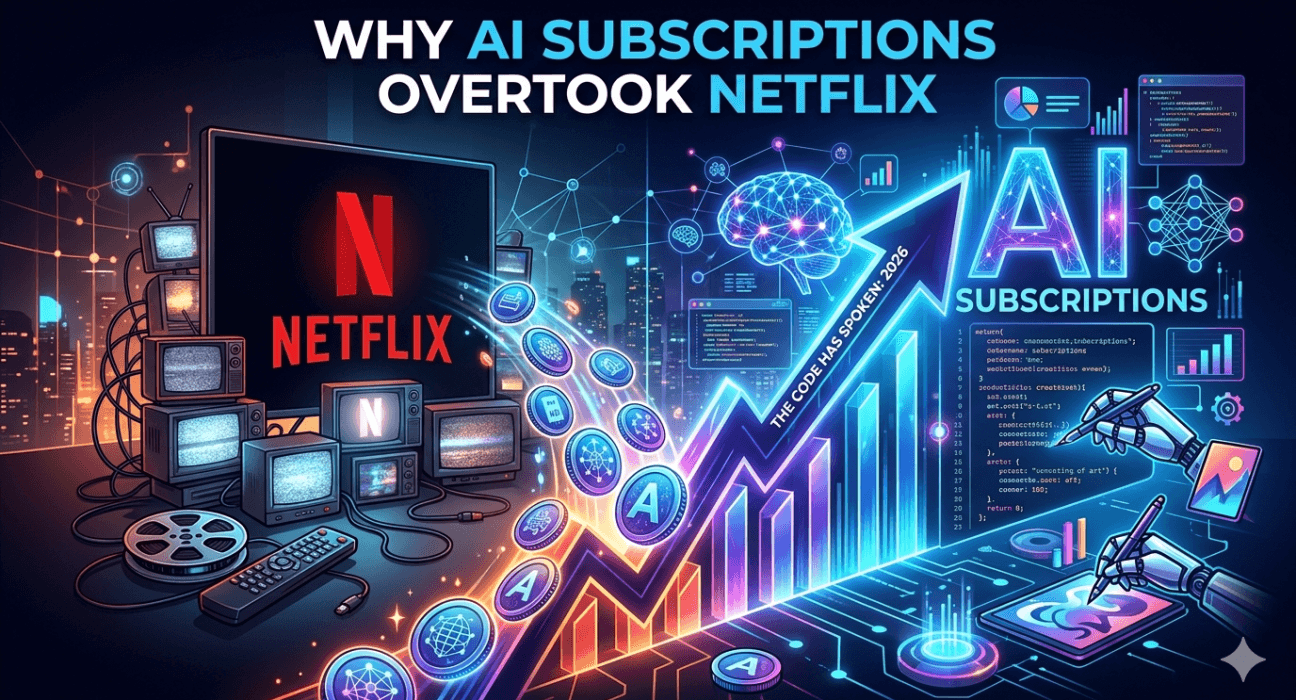
For the past decade, the ultimate metric of modern consumer culture was simple: What are you binging? The monthly Netflix subscription was a non-negotiable line item in the global household budget. But as we move through 2026, a quiet, tectonic shift is occurring in our digital wallets.
The passive entertainment economy is hitting a ceiling, and the active “Inference Economy” is taking over. For the first time, aggregate consumer spending on premium AI subscriptions—from advanced LLM copilots and autonomous agents to hyper-personalized productivity and creative suites—is on track to eclipse the total revenue of traditional video streaming giants.
The code has spoken, and humanity is choosing utility over distraction. Here is why 2026 is the year AI subscriptions officially dethroned Netflix.
1. From Passive Escapism to Active ROI
When you pay $15.49 a month for Netflix, you are buying a distraction—a way to kill two hours on a Tuesday night. When you pay $20 a month for an AI subscription, you are buying time.
In 2026, the novelty of “chatting” with an AI has evolved into specialized, multi-modal productivity. Consumers are realizing that a premium AI agent can write their code, format their legal documents, plan their taxes, or generate high-fidelity marketing assets in seconds.
- The Math of the Modern Wallet: If a Netflix subscription saves you from boredom, an AI subscription saves you 10 to 15 hours of work per week. In a hyper-competitive economic landscape, people are happily ditching a second or third streaming service to fund tools that literally make them money.
2. The Fatigue of the “Infinite Scroll” vs. Instant Creation
Remember when streaming felt like a curated luxury? Today, it often feels like a chore. Viewers spend an average of 10 to 15 minutes just scrolling through menus, paralyzed by choice, only to settle on a show they barely care about. Netflix’s own shift toward ad-supported tiers and live events acknowledges that the golden age of prestige, hyper-funded scripted content has plateaued.
AI flipped the script. Instead of consuming someone else’s content, users are building their own. With 2026’s creative AI suites, a subscriber can write a prompt and generate a 30-second broadcast-quality video clip, compose a fully arranged music track, or render a custom video game level. We have moved from a society of passive consumers to interactive creators. Why watch a rehashed sci-fi trope when you can co-author a dynamic universe in real-time?
3. The Rise of the “Omni-Agent” Lifestyle
A few years ago, people worried about “subscription fatigue.” The thought of paying for ChatGPT, Midjourney, an AI coding assistant, and a writing tool seemed absurd.
Enter the 2026 Omni-Agent. Major tech ecosystems have consolidated their offerings into single, powerhouse subscriptions that integrate seamlessly into your phone, your laptop, and your smart home. For the price of a single premium streaming plan, users now get a hyper-intelligent executive assistant that manages their schedule, summarizes their emails, tutors their kids, and edits their home videos. It’s no longer a niche software purchase; it’s an essential utility, right next to electricity and internet.
4. Personalization at the Molecular Level
Netflix’s recommendation algorithm was once considered the pinnacle of engineering. It looked at what millions of people watched and guessed what you might like next.
AI subscriptions offer a level of personalization that makes Hollywood’s best algorithms look prehistoric. A premium AI companion doesn’t guess what you want based on data from strangers; it knows your writing style, your coding preferences, your health goals, and your unique humor. It adapts to you over time, creating a sticky, high-retention relationship that consumers refuse to cancel. You can cancel Netflix and switch to Disney+ without losing your identity; canceling your trained AI assistant feels like a digital lobotomy.
The Bottom Line: Streaming platforms are fighting a brutal, low-margin war over eyeballs and ad revenue. Meanwhile, AI platforms are scaling exponentially by selling cognitive leverage. In 2026, the consumer budget has rewritten its priorities. Entertainment is fine, but empowerment is addictive.