





AI Agents vs. Chatbots: Why Your School is Moving to Autonomous Personal Tutors
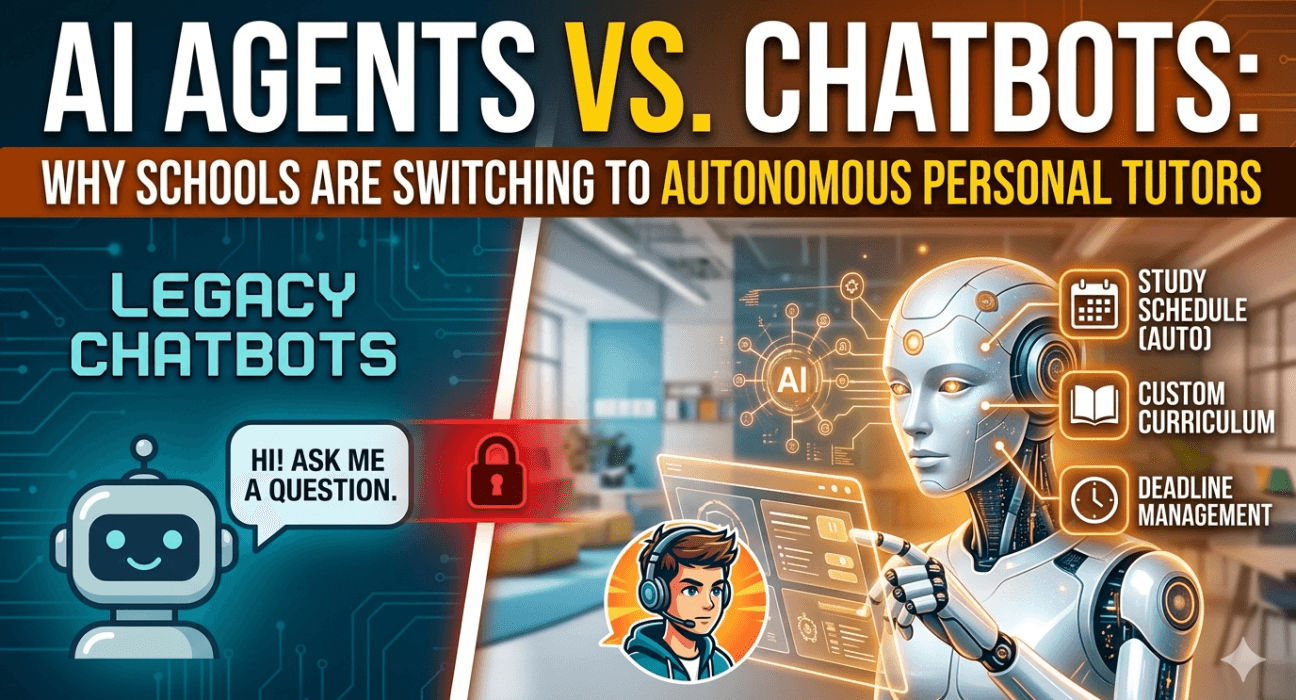
The era of “talking to a machine” is ending; the era of the machine “working for you” has begun. In 2026, the distinction between a simple chatbot and an AI Agent has become the defining line in educational technology. While chatbots were a digital library, AI Agents are becoming the digital architect of a student’s academic life.
The Evolution: From Reaction to Action
To understand why schools are pivoting, we have to look at the fundamental shift in how these systems operate. A chatbot is reactive—it waits for a prompt. An AI Agent is proactive—it understands a goal and executes the steps to reach it.
- The Chatbot (The Tutor): You ask how to solve a quadratic equation; it provides the steps. It is a one-off interaction that ends when the window is closed.
- The AI Agent (The Chief of Staff): It sees you have a Calculus exam in three weeks. It automatically blocks out study time in your calendar based on your historical energy levels, finds supplemental videos for the topics you struggled with last Tuesday, and sends a nudge to your study group to meet.
The “Autonomous” Difference
The 2026 academic shift is built on three pillars of autonomy that go beyond simple conversation:
| Feature | Legacy AI Chatbots | 2026 Autonomous Agents |
| Persistence | Session-based; forgets you after the chat. | Long-term memory; tracks progress over semesters. |
| Tool Use | Can only generate text. | Can access your calendar, email, and LMS (Canvas/Blackboard). |
| Logic | Answers the specific question asked. | Breaks down a “Grade A” goal into 50 micro-tasks. |
| Initiative | Waits for the student to “start” studying. | Reaches out when it detects “procrastination patterns.” |
Why Schools are All-In
Educational institutions are moving toward “Agent-First” campuses because it solves the scaling problem of personalized learning.
- Hyper-Personalization: Agents adapt to neurodiversity in real-time, switching from text-based explanations to visual simulations if the student’s engagement metrics dip.
- Administrative Relief: Teachers are no longer “assignment trackers.” Agents handle the logistics of scheduling, basic grading, and resource distribution, allowing educators to focus on high-level mentorship.
- The “Whole-Student” View: Agents don’t just look at grades; they monitor sleep data, extracurricular loads, and stress indicators to suggest a night off instead of a cram session.
The New Academic Reality
The move to autonomous tutors marks the end of the “one size fits all” curriculum. In this new landscape, the AI Agent isn’t just a tool in the student’s backpack—it’s the engine driving their entire educational journey, ensuring that no student falls behind because they forgot to check a syllabus.