






Astro vs. WordPress in 2026: Why the Market is Shifting to Static
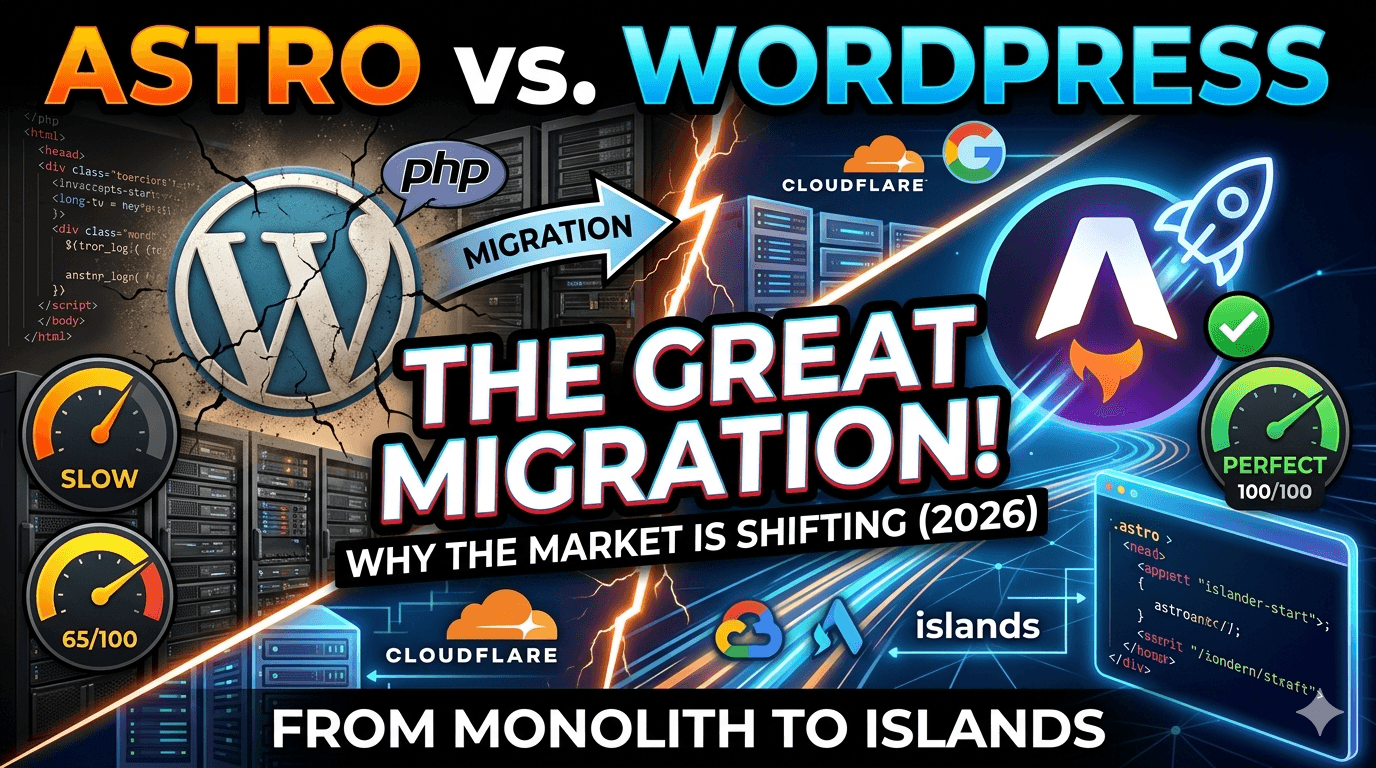
The shift from WordPress to Astro in 2026 is no longer just a “developer preference”—it is a strategic business migration. While WordPress still powers roughly 43% of the web, its market dominance is being chipped away by a new “Performance First” era where speed is the primary currency for both SEO and user retention.
Here is the breakdown of the market shift.
The Great Decoupling: From Monolith to Islands
For two decades, WordPress won because it was a “one-stop shop.” However, in 2026, the “Monolith Tax”—the heavy PHP and database processing required for every page load—has become a liability.
1. Astro’s “Islands Architecture”
Astro has disrupted the market with its “Zero JS by default” philosophy.
- The Concept: Instead of loading a massive JavaScript bundle for the entire site, Astro delivers pure, static HTML.
- The “Islands”: Interactive elements (like a search bar or a checkout button) are treated as isolated “islands” that only load JavaScript when they become visible or are needed.
- The Result: Sites hit 100/100 Lighthouse scores out of the box, something WordPress sites often struggle to achieve even with expensive optimization plugins.
2. SEO and the “GEO” Evolution
In 2026, search has evolved into Generative Engine Optimization (GEO). AI models like Gemini and others prefer clean, semantic HTML to parse data efficiently.
- WordPress: Often produces “div soup” (nested, messy code) due to heavy themes and page builders like Elementor or Divi.
- Astro: Generates ultra-clean, pre-rendered HTML that allows AI crawlers to index content faster and with higher accuracy, leading to better “AI-cited” search results.
Comparative Analysis: 2026 Benchmark
| Feature | WordPress (Monolithic) | Astro (Static/Hybrid) |
| Average Load Time | 2.5s – 4.5s | Under 1.5s |
| Architecture | Server-side (PHP/MySQL) | Static Site Generation (SSG) |
| Security | High risk (7,000+ vulnerabilities) | Extreme (No database to hack) |
| Maintenance | Weekly plugin/core updates | “Set it and forget it” |
| Hosting Cost | $20–$100/mo (Managed WP) | $0–$10/mo (Edge Hosting) |
The Hybrid Compromise
The market isn’t completely abandoning WordPress; it is demoting it. Many enterprises are now using Headless WordPress:
- Backend: WordPress remains the CMS where writers type their blogs.
- Frontend: Astro pulls that data via API and displays it on a lightning-fast static frontend.
This “Best of Both Worlds” approach allows marketing teams to keep their familiar dashboard while the company enjoys the performance and security of a modern framework.
Verdict: Why the Switch is Happening Now
The shift is driven by cost and conversion. In 2026, a one-second delay in mobile load time correlates to a 20% drop in conversions. For businesses, migrating to Astro isn’t about being “trendy”—it’s about eliminating the “WordPress Performance Tax” to protect their bottom line in an increasingly competitive digital economy.